Cosmetic Manufacturing: What Actually Happens After Your Big Idea

Factosquare specializes in both small- and large-batch cosmetic manufacturing. We often hear from founders who have a clear product idea but are unsure what happens between the idea and the first shipment. This article walks through the development stages from a practical perspective and explains where your role ends and your OEM/ODM partner’s begins.
Launching a beauty product is often pictured as a single creative leap, but most of the work is a series of technical steps, each with its own timeline. Brands that understand this sequence early can plan budgets and launch dates more realistically. The idea matters, yet how it is translated into a brief, a formula, and a tested product usually decides how smoothly a launch goes.
🔬 It Starts With a Brief, Not a Beaker
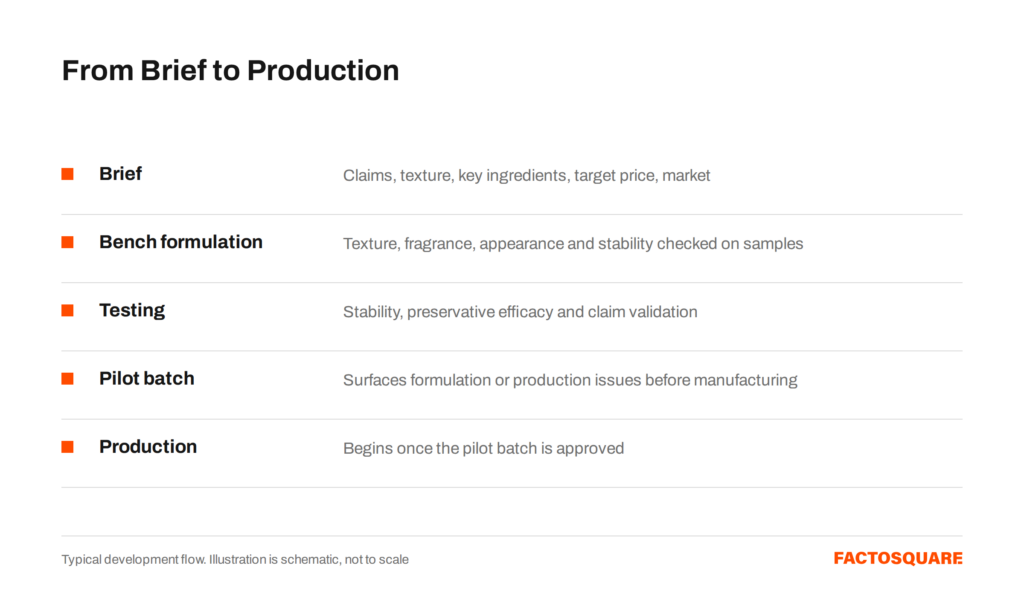
Before formulation begins, every product starts with a brief that outlines the desired claims, texture, key ingredients, target price, and market. The clearer the brief, the more efficiently the product can be developed. A well-defined brief saves time, cost, and revisions later, because the development team is not guessing at what you want.
🧪 Bench Formulation and First Samples
A cosmetic chemist develops the initial formulations, which are then refined through sample testing for texture, fragrance, appearance, and stability. Expect more than one round. Good products are usually perfected through iteration rather than approved on the first sample, so it helps to treat early samples as a starting point for feedback.
Testing Is Not Optional
Before production scales up, every formula should go through stability testing, preservative efficacy testing, and claim validation. These steps help confirm that the product remains safe and performs as promised throughout its shelf life. Building testing into your timeline from day one prevents surprises close to launch.
🏭 Pilot Batch, Then Production
A pilot batch helps identify formulation or production issues before full manufacturing begins. Once it is approved, the product moves into production, and each step carries its own timeline. A successful launch depends on getting every step right, not only on moving quickly.
❓ Q. How much of the development work do we need to handle ourselves?
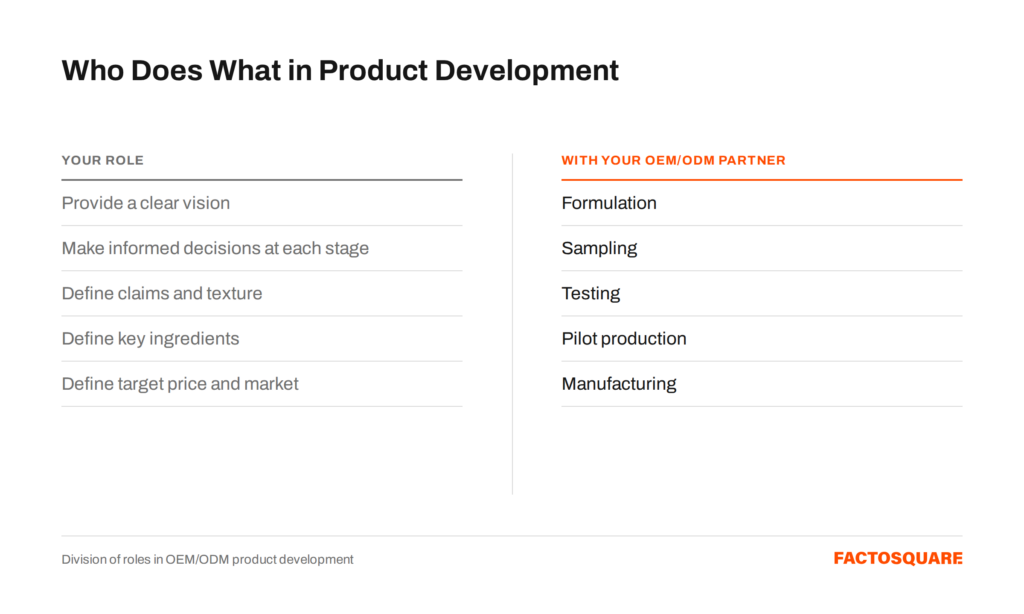
Less than most first-time founders expect. Most of the process, from formulation and sampling to testing, pilot production, and manufacturing, takes place with your OEM/ODM partner. Your role is to provide a clear vision and make informed decisions at each stage, such as approving samples and confirming priorities when trade-offs come up.
💡 Tips for Product Planning
✅Write the brief before you contact suppliers.
Settle claims, texture, key ingredients, target price, and market first, so every quote and sample starts from the same reference.

🛡️Schedule testing from the start.
Stability, preservative efficacy, and claim validation take time, and they are easier to absorb when they are part of the original timeline.

🧴 Plan for several sample rounds.
Refinement across samples is a normal part of development, so leave room in your calendar for feedback and adjustments.
In short, a product moves from brief to bench formulation, testing, a pilot batch, and then production. Your clarity at the start and your decisions along the way shape the result, while the technical work is carried out with your manufacturing partner.
Each of these stages also involves manufacturing questions such as formulation approach, stabilization, concentration of key ingredients, and batch size. If you are planning a new product and want to talk through the development path, the Factosquare team is happy to help. 📩
 채팅 상담
채팅 상담
 WhatsApp
 방문 상담
방문 상담